THE MARRIAGE BED

Rita was coming this morning to clean the house, and we knew from long experience that the best way to help her was to get out of her way. So, we jumped in the car and headed to Bevagna, which is a little over a half-hour away. Friends who’d been staying with us went to Bevagna for the first time last week and flipped over it, which inspired us to go back for another hit. Thank you, friends; thank you, Rita.
Unlike most ancient Umbrian towns, Bevagna’s not on a hill. It sits in the flood plain of two rivers, the Topino and the Clitunno -- and it’s surrounded by a wall that’s been protecting it all the way back to the Etruscans. Bevagna is a jewel.
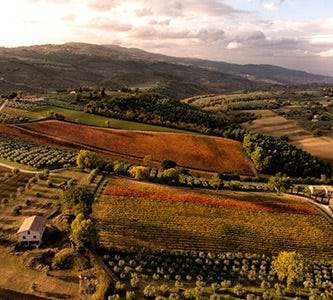
We drove there by way of Montefalco, which is very much a hill town. It’s called the Balcony of Umbria -- from its piazza at the top of the town you can see for miles in all four directions. Driving from our house up to Montefalco, it’s olive trees as far as you can see; when we circle around the top and start down toward Bevagna, it’s all vines -- endless rolling hills of grapevines. The wine harvest had just ended, so the vines were still showing their autumn colors.
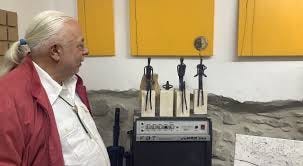
Bevagna was fairly empty, which was nice. It’s a tiny, ancient town, which has been beautifully tended to over the years. We meandered. We bought some cookies and a nice-looking loaf of bread. Jill was hot to find me a coat that I had lusted after online, which was, sadly, a fool’s errand. To look good in that coat, I would have to have a body like the model in the picture. I always forget that. We drifted behind the church in the main piazza to a sort of park -- a wide-open space with gardens and a view of the waterfall where the Clitunno river churns through the town. We were the only people there, it being a quiet Thursday. Then we noticed a guy working his way up the stairs from the street below. He was about our age -- so, old -- with a prosperous belly, a red bandana around his neck and long, white hair tied back in a ponytail. Okay, I thought, a bohemian, an artist, a man to know. He saw us, too. We were the only people in sight. He looked at us for a long moment.
“Buongiorno,” we called to him.
He nodded and continued to look at us. He waved us over.
“Da dove siete?” He wanted to know where we’re from.
“Dagli Stati Uniti,” I said.
His eyes narrowed, and he took another long look at us.
“Anche abbiamo una casa in Umbria,” says Jill.
“Dove?”
“Campello.”
He nodded again, and then he asked us if we lived in the lower part of Campello or the upper part. A lot of towns have an upper and lower part. Bazzano, for example, has Bazzano Superiore and Bazzano Inferiore. Which would you rather live in?
“Our house is between the two,” said Jill. “In the olive groves.”
“On the left? Down below?”
“Si!” He knew our house! It’s the only one down there.
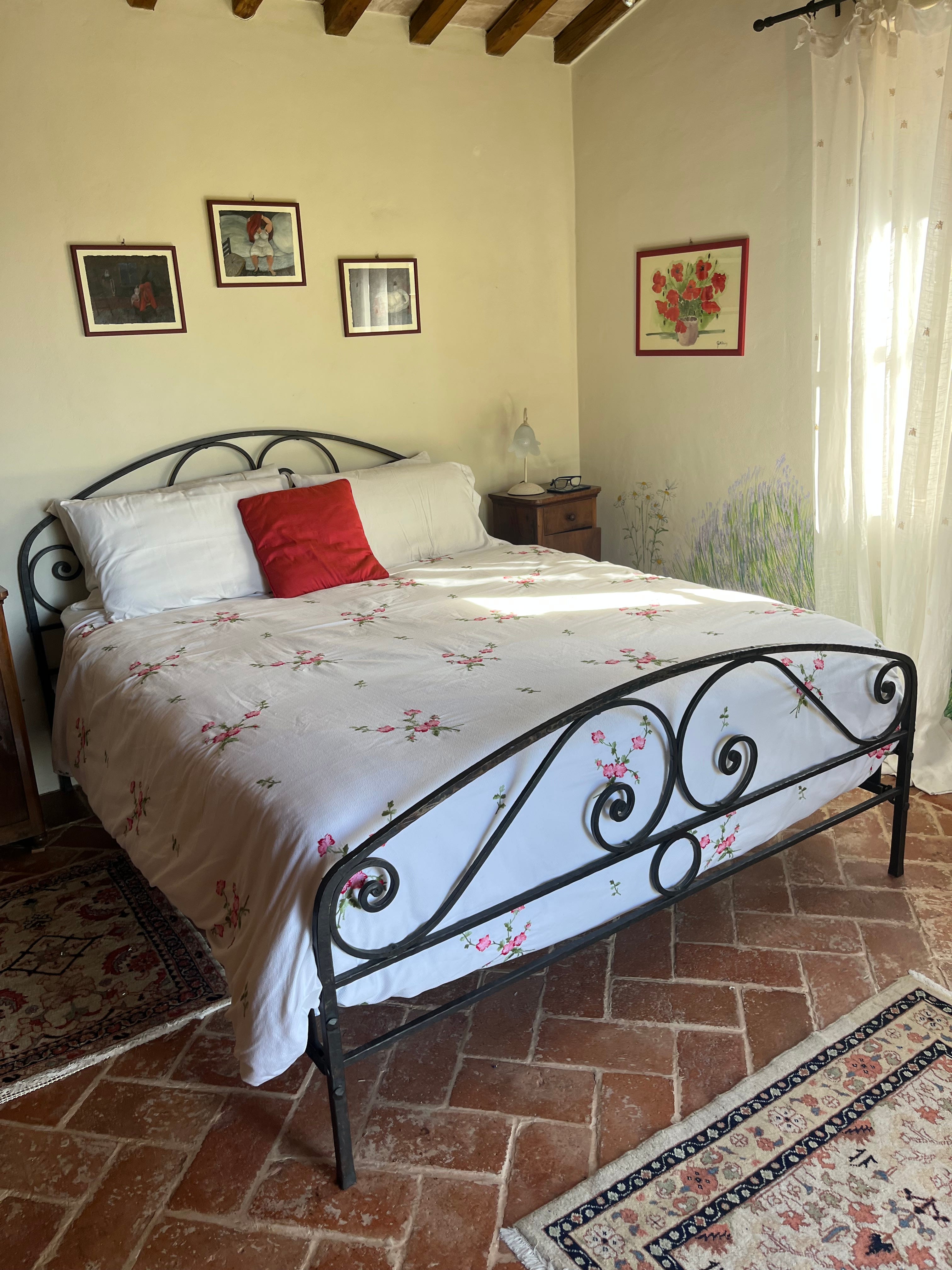
“Many years ago, I knew a couple that lived there,” he said in Italian. “I made a bed for them.”
Oh. My. God. That was us -- twenty-one years ago -- we had just finished an amplificazione -- an addition on the house, adding two bedrooms. And we had been strolling around Bevagna -- perhaps for the first time -- and we saw a bed in a shop window. It was made of wrought-iron, and we were drawn to it. It was stable on the floor; heavy, yet delicate. We went into the shop, which also displayed wonderful wrought-iron sculptures and asked about the bed.
“Could it be made in queen-size?”
“Yes, of course. It can be anything you want.”
“Can it fly?” I asked, and we laughed.
“That would be up to the two of you,” said Paolo Massei, sculptor, philosopher, dreamer.
What a great story and a lovely description of Bevagna, a charming town. The Mercato delle Gaite is wonderful.
A lovely story. The combination of belly-laughs (the fools errand/ "I always forget this" 😂, and landscape always landscape, and an underlying poignancy/tenderness. Sheesh. How you do this I do not know.