
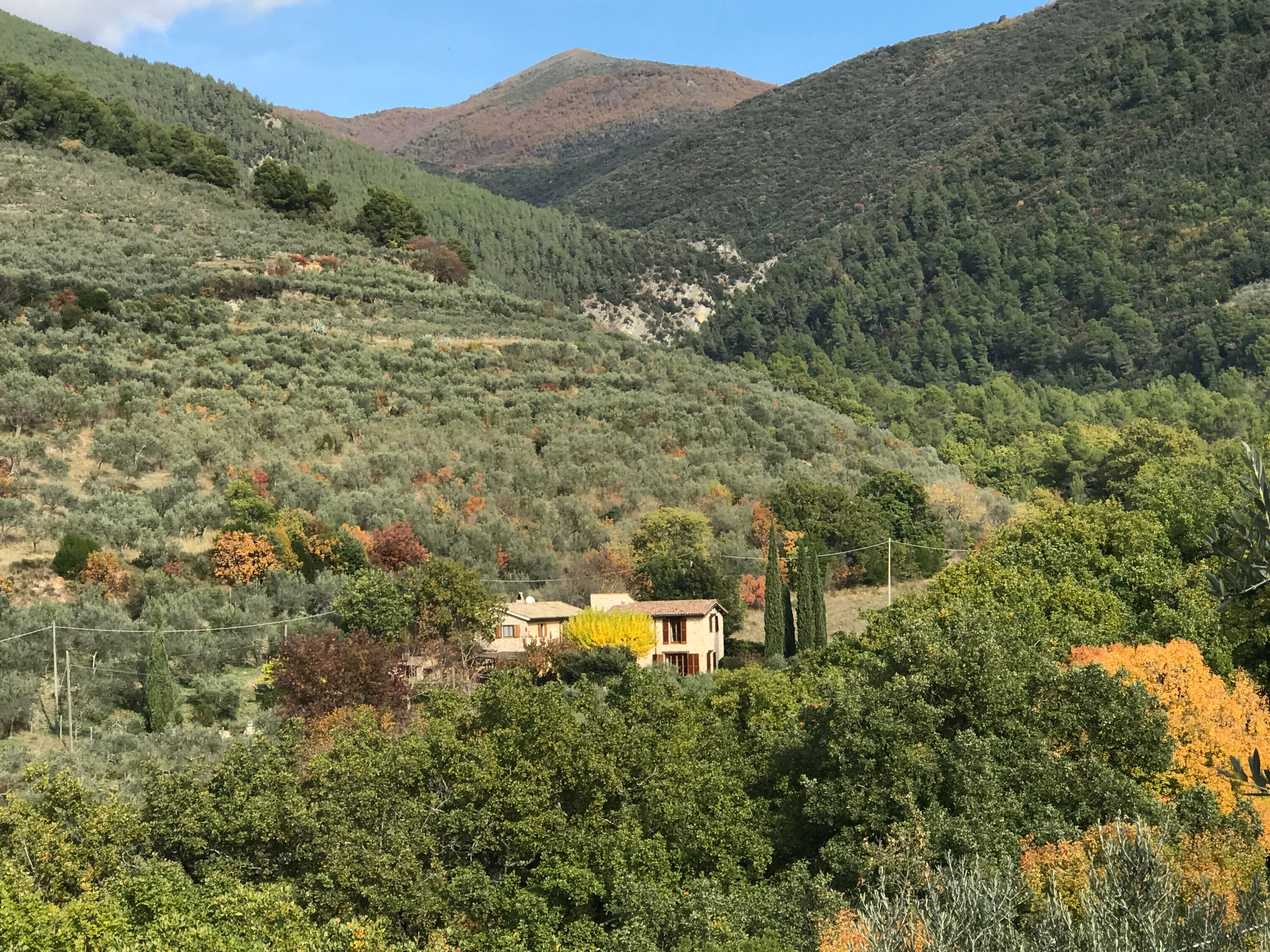
We wake up to a text from Alison and Francis -- that’s our daughter and son-in-law --saying their flight from JFK to Paris has been delayed. Which means their connection from Paris to Rome is up for grabs. Our son, Max, and his new girlfriend, Megan, are in the air somewhere over the North Pole, flying from Portland to Amsterdam, where they plan to make their Rome connection at Schipol, the Bermuda Triangle of airports. This plan was fragile to say the least: the two couples’ planes would arrive in Rome within minutes of each other, one from Paris, one from Amsterdam; they would meet at baggage claim, hug, gather their luggage and go out to meet the driver, who will be holding a sign. I mean, really.
“Stay loose,” ends Alison’s text. We had just flown over ourselves the day before, so I guess you could say we were loose.
Jill calls Alessandro, the driver, and tries to explain in her jet-lagged Italian what may or may not be going on with the kids and their arrival times. I stand to the side, offering occasional corrections to her pronunciation, which doesn’t go over well. After about five minutes of this, her jaw drops.
“What?”
“He speaks English. Really well.”
So, she tells Alessandro, in her impeccable English, to stay loose. He’s fine; he stays loose for a living. Then, she disappears into the guest bedroom to begin her morning routine -- Pilates, yoga, meditation -- she won’t emerge for an hour or so. I shuffle around from room to room in my socks, re-orienting myself, scratching variously, when the house suddenly fills with light. The sun just cleared the mountain above Silvignano. This is a good house.
I make coffee and do a crossword puzzle. Calling our kids “kids” is absurd, by the way. Our children are nearly as old as we are.
I have a second coffee and do another puzzle. Then, begrudgingly, I commit to the day. I find my shoes and wander out the door into a rather spectacular morning.
“Be here now,” I say to myself as I walk down the steps and into a field of olive trees. Well, perhaps what I said was, “Be here now, asshole.” Yeah, it was more like that.
The olives are more plentiful than I expected them to be. They’ve survived a brutal drought and heat wave over the summer and two violent thunderstorms in the weeks before we arrived. Has anybody noticed that the weather is getting kind of nutty?
The trees are heavy with fruit. We’ll have a busy time of it. They’re small, this season’s olives, a little more than half their usual size. That’s the drought. But small is not necessarily bad. It’s all about the ratio of weight to the yield of oil, the all-important resa. My guess is that the resa will be high this year. Or low. I can’t remember which is the good one. But it looks like it’ll be a fine year for oil. Our olives are piccoli ma buoni – small but good.
Yes, we have a house in Italy. And as I say those words, a drop of serotonin trickles its way down into my nervous system. We have a house in Italy. There, I did it again. There are so many ways to get high.
It’ll be twenty-two years this coming May that we first drove down the rutty dirt road and saw the cottage below, nestling into the foothills of the Umbrian Appenines. And in every direction, as far as we could see, were olive trees.
Our house is not a villa; not by a long shot. It’s a rustico, a simple, stone farm-worker’s cottage. It was four hundred and some years old when we bought it, and it’s twenty-two years older than that now. As are we. But the Rustico, which is both what it is and what we call it, beats us hands down at the longevity game. It was standing here when women wore wimples, and it’ll still be around after we humans succeed in obliterating our stupid selves from the face of the earth.
It exerts a pull on us -- the house, the hills, the sky, which is closer than other skies. We felt the pull the moment we saw it. We were based in Northern California in those days, six thousand miles from Umbria, but in less than a year, we moved back east to New York City, so that we could be that much closer to what we now thought of as home.
Our olive trees – the Italians call them plants – pianti -- were just twigs back then – seventy-five spindly twigs tied to sticks to keep them from falling over. They barely reached to my waist. Well, the twigs have grown taller, stronger and impressively fecund over the years, during which time I have grown progressively shorter and fatter. I now come up to their waists. And so it goes. Watching trees grow is not a bad way to mark time. It can make you optimistic, if you can get your mind off yourself for a second.
Covid. My god, Covid woke us up as to how tentative our grip is; how easy it could be to slide off the edge. We listened to the news about its dangers – especially for old folks. How they have to be really on their guard, what with their compromised systems. And then Alison called from Portland to remind us in no uncertain terms that we’re the old folks everybody’s worried about. Oh yeah, right. Denial’s great. Keeps you young.
The kids – there I go again – will miraculously arrive at Rome airport later this afternoon within minutes of each other, will be found by the driver (not by Alessandro, who is in a more executive position with the company, but by Carlo, who will show up a bit late and have a flatulence issue.) But all in all, everything will be actually, remarkably, just fine.
While waiting for them, I will cook. More and more, the kitchen is the point of my day, the place I go to gather myself after a day with the world. I will feed my children and their partners in such a way that they’ll have a soft, tasty landing and can then go off to their beds to recover from their twenty-four-hour travel day. They’ll have some minestrone, which will have been simmering on the stove for three or four hours when they arrive, filling the house with its intricate aroma. I will also make a shrimp and vegetable risotto, just in case.
A small Italian lesson: adding “one” (oh’nay) to the end of a word means that this is a big version of whatever the word is. So, minestra, meaning soup, becomes minestrone -- big soup. I’ll be making a big soup.
We’re in an interesting stage with our kids -- a wonderful stage, actually. Although, it’s not as if Jill and I interact with our children as a unit. She has her way, and I have mine. She’s a mom, and I am merely a dad. Moms are born nurturers. Whereas dads’ DNA urges them toward telling stale jokes and drinking too much at parties. We each hold our end up as best we can. In terms of the actual act of parenting, we’ve always operated in the good cop/bad cop mode -- she providing them with unconditional love and support; me urging them to learn how to support themselves, so that, eventually, they can support us.
Anyway, it all worked out. We have brilliant children, who are living brilliant lives. Alison’s a chef with a thriving catering business in Portland, Oregon. She’s also a wonderful writer. Her husband, Francis, is an architect and my hands-down favorite son-in-law. Max is a musician -- a kick-ass jazz drummer -- having the time of his life in the Portland music scene. He’ll be arriving with his new girlfriend, Megan, whom we have high hopes for. Yes, our children have chosen – each for their own reasons – to live as far as humanly possible from their parents and still be in the continental United States.
One thing that’s great is that they’re all artists (Megan, by the way, is a splendid singer/songwriter; also a jazz violinist). This makes a papa proud. Creative people have to be open to all sides of things. They do business with the light and the dark. They have only themselves, their own particular genius, to rely on for making a living. They seek the elation of the creative moment over the lunge for money, which I highly recommend. Money is fine. Up to a point. Anyway, it’s nice to see that our kids are in the creative life. I’m just going to call them kids and stop apologizing for it.
Jill and I had been assuming that we would sell the Rustico when we got too old and lame to make the trip. We thought it would be cleaner that way, saving our kids from having to deal with a piece of property in a foreign country. But recently we’ve been getting strong signals that this house is meaningful to them. They’re talking about being here every autumn for the olive harvest; they’re all studying Italian. Alison and Francis are of an age where they’re starting to think about the next phase of their life – call it their retirement or their semi-retirement. Semi-retirement is a wonderful concept. Jill and I have been semi-retired since we got out of school.
Francis has an Irish passport -- through his grandfather -- which makes him a citizen of the European Union. This will make it easy for them to spend as much time as they want in Italy. Max and Megan are younger and still on the make, as it were. All is as it should be. Last week, we got a message from Megan, whom we will meet in the flesh for the first time today, that she wants to gift us with a “house” guitar when she arrives. She sounds like a keeper.
Getting our things in order seems to be the order of the day as we edge into our eighties. There are all kinds of things, of course, that need to be attended to. External things like finances, friends, memories and hopes. We’ll make lists. And there are the internal things like, who am I, really? I mean, who would I be if I stripped away all the fake shit that I thought I needed to make an impression in the world? What’s left would be the real me, the pure, undefended me, the beautiful child, innocent and all-knowing. And wouldn’t it be wonderful to be that – even for just a moment in the time I have left?
The time left. Oh, Jesus. Jill and I talk about it a lot. We give each other courage. First one gives and then the other. Who will go first? That’s the big issue. What will the other do? I want to die first for sure, because I wouldn’t even want to be in the same room with myself after Jill is gone. But then I think if I go and leave her in the lurch – and what is a lurch, anyway? -- then how will she fill the bird feeder, which is a two-man job? Who will tell her to turn the burner down when she overheats the olive oil? Who will hold her and treasure her and pleasure her and make her laugh? Who will fly off the rails so that she can bring me back home again and make me whole? Who? Me. So I can’t die first, either.
We’ve looked at the issue from all sides; we turned it upside down and inside out, and finally we decided it would be better for us to live forever. We’ll run out of money eventually, but that’s okay. When you’re a hundred and eighty-six you don’t need much.
Who will go first… 🥹 so touching what you wrote there
Your stories are always unique yet so relatable. My parents, 86 and 91, still consider me a kid. In a way, we all are someone's kid at one point. I dread the day I am no longer anyone's kid. Wishing your family many more happy times together!