SPUDS
Now available as an Audio Story read by Michael Tucker

In the tiny Umbrian village of Aqualoreto, there’s a piazza that’s barely big enough to call itself that; just two streets crossing at an odd angle with a stone monument dedicated to the town’s casualties in World War Two. And on one crooked corner is the Osteria La Cruccola, which is a place you should visit if you get the chance. You’ll have to reserve in advance because the patrona, whose name is Neysa, plans the evening’s menu around who’s coming that night. If twelve people reserve, she cooks a dinner for twelve. There are few choices. If you happen to be a vegan, you’d be smart to let her know in advance, although she always serves ample vegetables and grains.
Neysa is in charge of everything and it’s best to accept that before you sit down. She was once a schoolteacher, and she doesn’t take a lot of guff. As far as I can tell, she’s the only one there. She greets you; she seats you; she cooks your dinner, serves it, clears the plates, and if she’s in the mood, she’ll philosophize a bit with you after dessert. If she’s in the mood.
One night I had her roast chicken, and one of the contorni – which are side dishes that you order family-style along with the main dishes -- was a plate of roasted potatoes. The chicken was very good – all the food Neysa cooks is real food. But the potatoes made me stop and go back for another taste because they couldn’t have been as good as I thought they were -- and in the process I finished the plate, which was actually meant for everybody at the table. I called Neysa over after dinner and asked her what she had done to make these incredible potatoes.
“L’ho cucinati.” I cooked them.
“But they are ottimo,” I said. The best translation of this wonderful word is “better than good.”
“Because,“ she said in Italian, “they are good potatoes.”
“Ah.” I said, “And where can one find these potatoes?”
She bent over so that her face was close to mine, but not so close that she couldn’t raise a forefinger in front of my eyes and wag it back and forth like a windshield wiper.
“No,” she said, which means roughly the same as it does in English, but with the finality of death. It meant there was no way I would ever learn from which farmer she had procured these splendid potatoes. And splendid they were. Ottimo. Italians are remarkably generous people, but not with their potatoes.
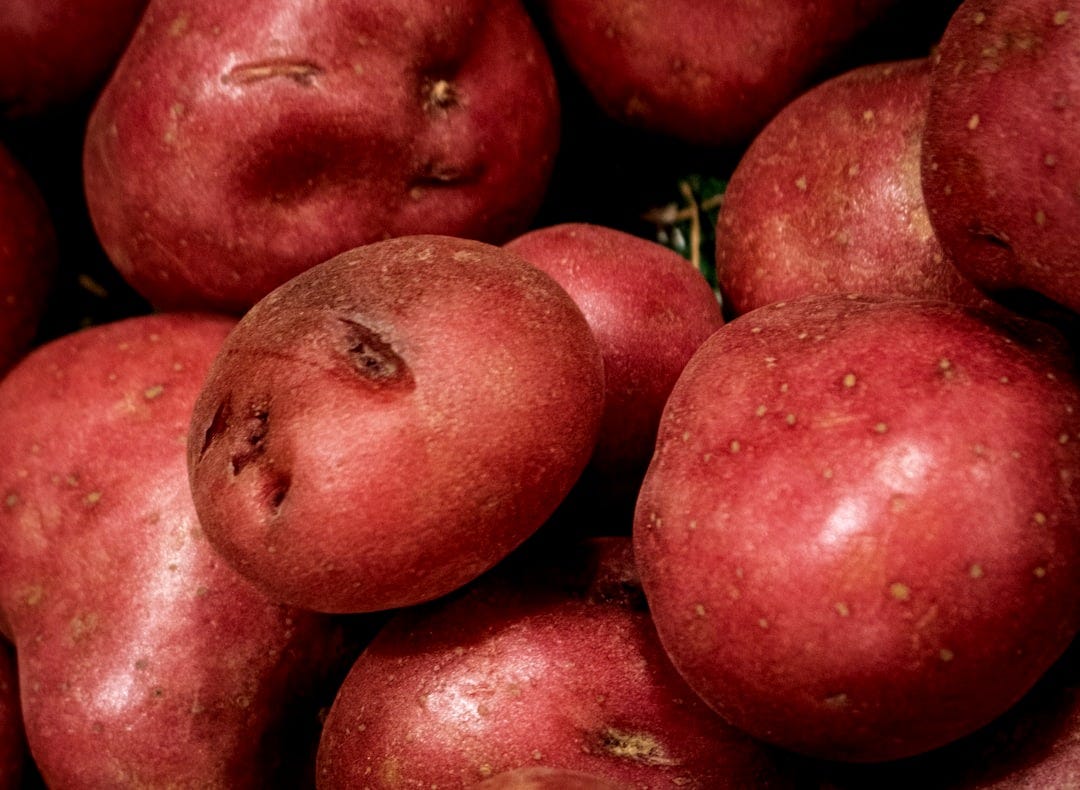
Although, there’s another story that belies that. High up in the Appenine foothills, about 2500 feet above the Umbrian town of Foligno, is the farming village of Colfiorito. It sits on a fertile plain that marks the border between the regions of Umbria and Le Marche. Its lentils are famous, and you can find them in good markets all over the world. Its red potatoes – every bit as famous -- don’t travel as far so it’s best if you come to them. The official name of the potato is Désirée – it’s a red-skinned potato – and the locals in Colfiorito believe that it has to be cultivated high up in the Appenines if it’s to come into its perfect self, as it does in Colfiorito.
We took a drive up there to check out a restaurant I had read about. It’s called La Botteguccia del Campo 64, which is a name I’ll try to parse for you.
A botteguccia is a small shop, which is how Stefano and Nunciatina started out. Just a little shop, right off the highway that runs from Umbria to Le Marche. Their shop sold Colfiorito’s treasures – lentils, red potatoes, truffles, sausages, local olive oil and cheeses – pecorino from their sheep; mozzarella from their cows. Nunciatina would also make fresh ricotta every day and schlep it from her home kitchen to the store, and the crowds started to grow. Stefano, being a man of vision, saw the potential. All he had to do was borrow the money to build a kitchen onto the back of the store and then chain his beautiful wife to the stove so that she would cook lunch and dinner six days a week until they were rich. They’re still working it out.
The second half of the name of the restaurant – del Campo 64 – refers back to the Second World War. The Fascists built an internment camp in Colfiorito – think large empty fields strung with barbed wire fences -- to incarcerate Gypsies, Jews and various anti-fascists. The Fascists, it seems, didn’t like anti-fascists. Anyway, Campo 64 – field #64 – was roughly where the restaurant stands today. Stefano is an ironist. He’s also one of the greatest tummlers I’ve ever known. A tummler, as defined by Vebster, is a comic entertainer or social director at a Jewish resort. Stefano knows how to work the room.
We arrived with no foreknowledge of the experience we were about to experience. We’d thought we’d have an Umbrian meal up in the mountains – simple, honest, pleasing fare with wine from the neighborhood. But then we had the experience that we experienced.
La Botteguccia is more a roadhouse than a restaurant. A hefty breeze could knock the building down – not to mention the earthquakes which occur regularly in the region. But there it still stands, feeding all sorts of interesting-looking people -- families with hungry kids, bikers, adventurous foodies, lots of lefties and bohos, lots of farmers. The walls are covered with favorite poems and quotations supplied by happy eaters over the years. There are poems to Nunciatina’s cooking; there are photos of Che and Einstein. It’s that kind of place.
We arrived around 8:30, and the Botteguccia was already jumping. Stefano, his arms lined from wrist to shoulder with plates of food, smiled at us when we came in and indicated with a nod of his head the table where we should settle ourselves. Within a minute or two, he came over and asked our preferences for water and wine. There was no menu, no wine list. Jill mentioned to him, in her impeccable Italian, that she was a vegetarian, and he stopped and took a look at her. Stefano has an innate appreciation of women.
“Also my wife,” he said to her. “Also vegetarian. But I make her cook meat for everyone else. Don’t worry,” he cooed to Jill, turning his back to me, “I will take care of you.”
We looked around the room and noticed that everyone was being served the same dishes. That’s the way it works at La Botteguccia. Nunciatina cooks a course and it’s served to everyone in the room. Then she cooks another.
Minutes later, Stefano brought us a plate of bread and a pot of ricotta, still warm.
“This is our bread,” he said, “made fresh every day with local organic wheat. This is Nuncia’s ricotta. There is none better.”
This turned out to be an understatement. If God could cook, this would be his ricotta. I tore a piece of bread in half, slathered some ricotta onto it and took a somewhat larger bite than I should have. This happens to me sometimes when I get excited. Jill watched me trying to negotiate my mouthful and shook her head sadly. To take her mind off my bite, I made one for her. As a quasi-vegan she eats very little cheese, but she’d be a fool not to taste this. She tasted; she tasted again and then she took a real bite. She was hooked. Jill likes a bit of sweetness in the under-taste, and this ricotta delivers on that score. I tore another piece of bread in half and made another serving for each of us. Across the room, I noticed Stefano looking at me and holding out his hand – palm down – and waving it up and down in the universal signal to slow down. He was telling me that there was a lot more to come and that I should think about pacing myself.
He worked his way to our table and filled my glass with red wine, a blend of Montepulciano and Sangiovese grapes, which thrive in the region. He left the wine pitcher on the table, along with a plate of crostini with liver pate. Jill started to remind him that she doesn’t go that way, but he quickly held up a finger and said, “I know; don’t worry; trust me.” The liver, by the way, went down very nicely with the wine.
The next time he appeared he was holding a large tray with bowls of zucchini vellutata that he served, table by table, to everyone in the room. This was a perfect dish for Jill.
A vellutata is a pureed vegetable and potato soup. Nunciatina makes it with whatever vegetable is freshest that day. She’ll sauté the veg with the diced potatoes, then add a bit of vegetable broth; then puree it all in a blender. That’s it. The potatoes are not there merely as a binder or filler; they bring the taste of the Colfiorito red potato into the soup, which we inhaled.
Stefano also brought a plate of grilled pancetta to go with the soup. He carefully placed it out of Jill’s reach.
“Only for you,” he said to me with a sly grin. Maybe he’s not just interested in women; maybe he likes people.
The next course was a plate of their homemade mozzarella, drizzled with their olive oil; after that was a big salad bowl, fresh from the garden; then came a plate of green beans, just off the vine or the bush – I can’t remember what they grow on. These dishes were remarkable for their simplicity. When we tried the salad, we were struck by the taste of lettuce when it’s really fresh; the beans snapped with the particular green essence of beans – no herbs, no vinegars, no hot pepper, no bacon bits; just green beans, a little oil, a little salt.
Jill caught a break with the next course, which was decidedly non-vegetarian – a plate of hard and soft home-made sausages -- salami, cotechino and something called ciauscolo, which is the Le Marche version of ‘nduja, the soft, spicy sausage of Calabria. Just spread it all over that homemade bread.
A big bowl of lentils came next – the famous Colfiorito lentils, which lived up to their reputation. Stefano placed the bowl on the table in a spot favoring Jill and slipped me a grilled lamb chop to chew on while she tucked into the lentils. When she had her fill, she looked at me like she had just had a religious conversion. Or perhaps an orgasm.
“I’ll never think of lentils in the same way again. They used to be something I should eat; now I can’t imagine ever wanting to eat anything else.”
Then Stefano suggested a little pause. Una piccola pausa. This was a good idea, as we were flirting with the edge of gluttony, what with all those tastes and the wine pitcher that was somehow always full. I think this pause in the action was also a way for him to build up some dramatic tension before he brought the next course, which was the star turn of the evening and the inspiration for this lengthy dissertation.
There was no fanfare, no drum roll. Stefano simply placed a plate on the table that contained two red-skinned baked potatoes, each sliced in half. He stood by, armed with his bottle of the greenest, opaque-est olive oil I have ever seen, and waited for us to serve ourselves. When we were each in possession of our own personal spud he poured a generous glug of the oil onto the sides of our plates and stood back.
“Un po’ di sale, forse,” he said with a shrug. Maybe a little salt.
Well. Maybe it was because our palates had been refined over the evening, cleansed of all those distracting condiments and spices we’ve had to put on our food because our food wasn’t fresh. We had been re-virginized.
The potato tasted of the earth, mingled with the sweetness that starchy tubers give off when they come to a certain temperature. And not from any old earth, but the rich soil of the fertile plain of Colfiorito at 2500 feet above sea level. The oil and the salt were wonderful additions, but I decided to experience the second half of my potato on its own, with no help from the Pep Squad, and it was … ottimo.
Pasta was next. Stefano brought out a large pot filled with mezze maniche in a ragù, which is Italian for meat sauce. Mezze maniche is like rigatoni but cut in half. The meat for the sauce was from the chianina cows that graze on the neighboring hillsides. The chianini have been raised in Umbria and Tuscany since before the birth of Christ. Their greatest claim to fame is the bisteca Fiorentina, the mammoth porterhouse served famously in Florence. If it’s not made with chianina beef, it’s not a Fiorentina. It also makes for a kick-ass ragù.
Stefano made his way over to us, carrying two steaming bowls of the pasta. He set them down on our table and immediately raised a finger to stop Jill’s protest.
“For me,” he said. “Not for you.”
He reached into his pocket, took out a wine glass and filled it from our pitcher. Then he sat down to have some dinner and to get to know us a bit.
“Siete Inglese?
“No, siamo Americani.
“Ah! America the beautiful!” he said in English.
“And you are married, of course,” he said.
We nodded.
“Ovviamente,” he said. Obviously.
Then he called to Nunciatina to come out and we introduced ourselves and complimented her on the dinner. Jill and I instantly fell in with them, as if we had been friends for years. They liked the same things we liked and vice-versa; they got our jokes, and we got theirs. Within moments, there was a circle of warmth surrounding the table.
There’s a sign on the wall that was nearby to our table, hastily written in block letters on a plain piece of cardboard. It’s one of the fifty or so handmade signs that decorate the walls at the Botteguccia. This one says, roughly translated, “In this place no one is a stranger, but friends we have already met.” I got a bit emotional about this – well, a lot of wine had gone down – and I tried to express to them how magical this evening had been for us. Stefano and Nunciatina shared a look, and then Stefano said to us, “This plateau that divides Le Marche from Umbria, in the middle of Italy, on the border of everything, is a kind of Shangrila: it offers everything – not just the red potato but happiness.”
Jeepers how I love reading these pieces. So often of late when I'm reading I find myself skipping through or past or just stopping, but not for your stories. Thank you!
Hello, Mr. Tucker! I am so glad I get to read your beautiful writing again. I really enjoyed your book “ Living in a Foreign Language: A Memoir of Food, Wine, and Love in Italy” many years ago. Your many stories are so inspiring, and they also help bring people together. Looking forward to reading more about your new adventures.