COWS
Now available as an Audio Story read by Jill Eikenberry

When we’re in Italy, we take a walk pretty much every day –weather and mood permitting. Now, I don’t want to give a false impression; it’s not like we take hands and skip merrily up the road together. A lot of the time we walk separately, with me a half block in front, trying to get the whole thing over with as quickly as possible, talking to myself, gesticulating, spewing bile at the various and nefarious of the world. And Jill trails behind, blithely cleaning up the mess, poofing away my bile with a wave of her hand, as the chipmunks and bluebirds dance around her and sing. Our walks are more like that.
I don’t hate to walk, by the way. That’s simply not true. I am a recalcitrant walker, a begrudging walker, yes. But that’s because my body, when it’s at rest, tends to stay that way. Which is science. Look it up.
Also, I don’t mind walking when it’s my idea. Okay, now we’re getting somewhere. Because Jill wants it to be her idea. She needs it to be her idea. Because then, if I live longer, she wants to take full credit for it. She wants to be able to put that on her resume under ‘special skills.’ “I have a living husband and it’s because I made him schlep up that fucking hill every day.”
The problem is, I don’t like being told what to do. This comes from … my childhood, my mother – we don’t need to go into that -– but bottom line, I don’t like doing something because I was pushed into it. My to-do list is conceived in my imagination and functions at the service of my desires. That’s my formula. And if that process happens to lead to my taking a walk, great. My imagination is perfectly capable of imagining a walk, a gambol, perhaps. But to crawl up a hill every day just to get my heart beating so that I won’t die is just sad. It doesn’t work. Healthy people die all the time. Okay, I’m done.
Jill wants me to be alive. She wants to spend her time with me. That’s not a bad thing. Her heart is in the right place. While mine is rotting away like an old crabcake.
So, every day, as a sop to my begrudgment, she asks me which way I would like to walk. There are two possibilities once we get to the paved road at the top of our driveway: to the left – a brutal three kilometer slog, straight uphill, every agonizing step. Or, we can turn right and take a breezy jaunt down to Poreta. I know: if you go down the hill on the way there, you’ll have to come up the hill on the way home. I know. But that’s okay for me. Heading home, I’ve got my eye on the red couch in the living room, where I’ll put a couple of pillows under my head and read my book until my eyelids fall. Heaven on a stick. But if we start our walk up the hill, I’m moving away from the red couch. Not the same. It’s all about desire.
So, we walk to Poreta, which is the nearest town to us. Although Poreta’s not really a town. There’s no city hall, no police station or firehouse. Poreta is a frazione – meaning a fraction or suburb -- of Spoleto, which is a real town. But Poreta has its charms. Poreta is ancient and she flaunts her age. That’s an attraction for us. We tend to be drawn to things that are crumbling. Yeah, Jill, too. Even though she keeps herself young and healthy, eats well, exercises, takes all the supplements – what she’s drawn to is crumble and decay. Look at her choice of husband. When we met in our early twenties, I was already crumbling. We like old buildings, old cities, like Naples or Palermo. And ancient stands of redwood trees that have grown close together so they can hold each other up. We like comfortable old couches and crusty old songs and old people, too. Not because they’re crumbling, but because they’re heroic. Old people are heroic.
Poreta has a walled castle dating back to to the year 1196, which stands – essentially intact -- high above the town. And there’s a church down below that dates back almost that far, which closed its doors after the earthquake in 2016 and will now be left to crumble in peace. There’s a main street, which could be the narrowest two-way street in the world and which is often traffic-jammed with a large herd of sheep. Poreta is surrounded by tens of thousands of olive trees, which provide its main industry. And that’s about it for Poreta.
We first saw the view from the Castle – up above -- on the day we first saw – and decided to buy - our house here in Umbria. We were being shown around by Joanna Ross, an ex- William Morris agent, who had been living in Umbria with her husband and son since the late Seventies. She told us to call her JoJo, which we’ve been doing now for the last twenty one years. It was one of those days that change your life forever. JoJo ordered a bottle of the local Grechetto and she told us stories of Hannibal and the battle of Lake Trasimeno, where the Umbrians stopped Hannibal’s march to Rome and the lake ran red with blood. JoJo’s very dramatic. She gestured to the vast and beautiful Spoleto Valley that lay at our feet and pointed out its ancient hill towns:
“Okay,” she said, “From left to right: Spoleto, Montefalco, Trevi, Spello, Assisi and if you squint a little bit, you can see Perugia.”
We squinted and there it was.
“In the old days these hill towns would declare war on each other at the drop of a hat. Whenever they had nothing better to do, they would armor up and spend the weekend slaughtering their neighbors.”
Or so it was told to us that day by the venerable sage and historian, JoJo The Elder.
Poreta has a store. Just one. And that store and its owner, Rosella, are the subject of this story. Rosella is Poreta’s town quirk. For many years, she kept a pet goat named Betta – a big, fat black-and-white goat - tied up to the wall outside her store and twice a day she’d snap on a leash and walk Betta proudly through the town. Things like that can get you a reputation.
Betta’s been dead for a while now, and Rosella keeps a photo of her on the counter. Kind of like a shrine.
Rosella’s is a convenience store, but not very. She sells some tobacco; she sells a few newspapers; you might find a can of white beans on the counter. On a good day, she might have some goat’s milk, maybe a carrot or two. Rosella’s is more about Rosella than anything she might have to sell.
We first met her shortly after we bought our house. Our Italian wasn’t very good and Rosella’s English was, if anything, worse. So, our discussions were more about trying to communicate than actually doing the deed. But we enjoyed ourselves. Rosella is no fool. She’s well-read and has a fine sense of irony. We just couldn’t understand ninety percent of what we were all saying to each other. Our early conversations consisted mostly of Rosella drawing us out. Where did we live in the States? What did we do for work? What brought us to Italy? And we in turn asked her as many questions about her goat as we could think of. And we merrily stumbled along.
When we described to her where our house was, she got very excited.
“Cé un forno, no?”
She was saying that our house has a wood-burning oven that dates back to sometime in the sixteenth century. The oven was there before there was a house. It was where everyone in the area came to bake their bread. And when the baking was done, I imagine, they threw in a pig or a lamb -- just to round out the afternoon. Rosella told us that our tiny house once belonged to the local Count. It was the last piece of a large estate that had been chipped away at over the years. Noble Italians have a way of gambling away their fortunes. Our house was where the migrant farm-workers stayed during the harvest. It had two rooms below and two up the stairs. The rooms below housed the animals and their body heat warmed the rooms above where the workers slept. Underfloor heating, Middle Ages-style.
The oven, which is large and could bake bread for many families at once, is still in use – by us. Mostly we do pizza parties, although I remember through the haze of numerous bottles of wine, that we did a whole pig once. We had a friend -- a professional chef -- and he made a feast that’s still talked about.
Rosella remembers that when she was young, there were gatherings around the oven during the harvest to feed the workers, who would come in from the olive groves with a sharp appetite. Families, with kids and grandparents, migrant workers who came over from Albania or Croatia, everybody was hungry. You could tear off a chunk of bread, fresh and hot from the wood-oven, droozle some of the new oil onto it and fold a sausage inside. I’m making all this up, but it had to be something like that. Our oven was the center of the party, she said, and we could see she was having a good memory.
“Life is good here,” I said – in my broken Italian.
She sighed and shook her head, no.
“What?
“It’s not the same. No more.”
“Why?” asked Jill. We wanted it to be the same.
Rosella let out another sigh.
“What? I said again.
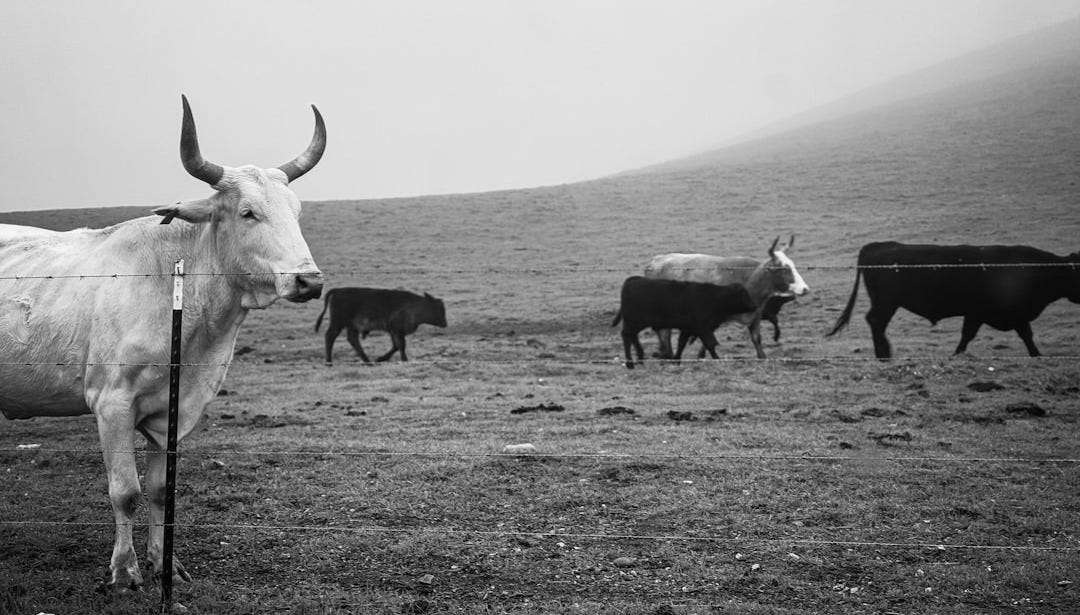
“The cows,” she said. “The cows.”
We nodded because we didn’t know what else to do. And she made that wonderful Italian gesture with her right hand. She put the tips of all her fingers together, face up, and slowly shook it back and forth, like a maraca. Her face was a mask of tragedy.
“The cows,” she repeated.
What cows? There were no cows here. But we didn’t want to look stupid, so we nodded, sagely and said, “Si, si, the cows.” And we solemnly took our leave.
‘What the hell was that all about?” I said, on the way back up the hill.
Jill shook her head and sighed. She was becoming more Italian every minute.
“There’s a herd of cows in the valley,” I said. Over the hill from Silvignano.”
“But why would that make Rosella so sad?” said Jill.
“Is it possible she was talking about Betta?”
“Betta was a goat.”
“Yeah, but you know how sometimes female whales are called cows?
“Yeah.”
“So, a goat’s a lot closer to being a cow than a whale is, no?”
We trudged home in silence, our afternoon tainted by the mystery of the cows. Finally, we decided to call JoJo, who if she didn’t know the answer to this mystery, would make something up equally as good.
“She wasn’t saying cows, Mikey. She was talking about chaos. Same spelling in Italian; different pronunciation. Think K A O S Kaos – like the Greeks.
“Rosella was lamenting the disconnect between people in the world today – the breakdown of civility between governments, between political parties, between friends and neighbors, who a short time ago could sit and discuss things with people they disagreed with without threatening them with death and dismemberment.
“She was despairing of the chaos, not the cows. Cows don’t think about shit like that.”